Maarten de BruinThe Acceleration Gap
The book

The Acceleration Gap

Why organizations cannot act on what their buildings already know. Business Expert Press, expected early 2027.

The argument in three moves

A governance problem wearing a data problem's clothes

Most organizations answer the gap by improving the data. The data was rarely the constraint.

The building observes

Access systems map movement. Environmental systems track presence by zone. Booking platforms document, in their silences, when a reservation never became occupation. Together they produce a continuous record of how work actually happens in space.

Visibility

The signal decays

A cross-domain finding is split into functional agenda items. Each function evaluates its fragment against criteria it already holds. The pattern that gave the finding its force was never presented to anyone whole.

Translation

Nothing follows

The finding is acknowledged, filed, and reclassified as a managed item. The floors keep running at the same rate and the lease keeps paying for them. The organization did not refuse the evidence. It absorbed it.

Consequence
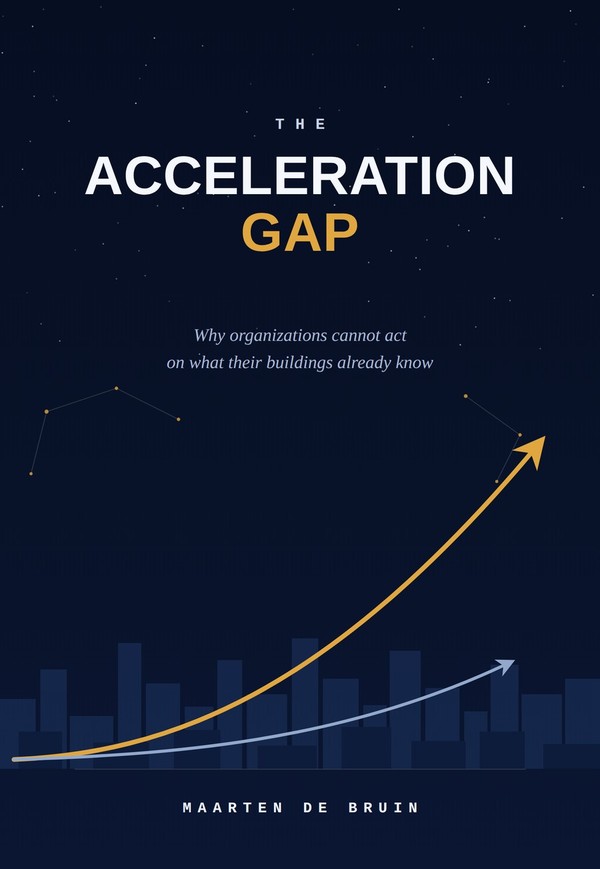
Cover of The Acceleration Gap by Maarten de Bruin
Publisher
Business Expert Press
Expected
Early 2027
Length
17 chapters, prologue and epilogue
Language
English
Status
Manuscript in production
Description

A floor runs at 30 percent occupancy for a year while the lease that pays for it keeps running. The sensors saw it first. The facility team reported it months ago. The finance team would care if the finding reached them in their language. Somewhere between the building and the boardroom, the signal lost its force, and the organization carried on as if nothing had been measured.

This book is about that distance. Buildings have learned to speak in continuous, precise detail about how they are actually used, and most organizations still decide about them at the pace of quarterly reviews and annual plans. The gap is not a data problem, and it is not a communication problem. It is a governance problem: decision structures built for an era of scarce information are now surrounded by abundant evidence they were never designed to act on.

The Acceleration Gap explains how that gap arises, why intelligent organizations defend it, and what it costs in lease commitments, energy, and credibility. It gives leaders a way to recognize the mechanisms at work in their own governance, to measure how long their organization takes to act on what it already knows, and to redesign ownership, decision rhythm, and incentives so that the next signal produces a decision. With sustainability reporting and investor scrutiny making the answer publicly visible, the better moment to close the gap is before someone outside the organization asks why it is still open.

Who it is for

Executives, heads of real estate, facility and workplace directors, and the finance and technology leaders who sit across from them.

How it is written

Theoretical foundation combined with management observation. Narrative rather than technical. No organization in the book is named.

What it gives you

Four process measures you can compute from records you already hold, and a redesign sequence: own it, tier it, price it.
Contents

Seventeen chapters, in sequence

The early chapters establish what continuous building data reveals. The middle chapters examine the mechanisms that prevent the revelation from producing decisions. The final chapters describe what closing the gap actually takes.

Part one · What the building reveals
01
When technology outruns the organization
Building technology and organizational governance once moved at comparable speeds. That proportion broke, and the informational structure that made it manageable broke with it.
02
Seen through its buildings
The difference between data that describes an organization and data that observes it. Surveys answer within the frame they created. Buildings do not.
03
Signal decay
How a clear cross-domain finding loses force at each layer between sensor and decision, while every layer behaves correctly by its own standards.
Part two · Why it persists
04
Why the organization defends the gap
Functional performance measurement makes cross-domain action individually irrational for every function that would have to take part.
05
Balance sheet
Real estate sits among the top cost lines and shapes the capital structure, yet the people managing it rarely have a direct line to the behavioral evidence.
06
Lost in translation
A finding correct in facility language arrives at governance stripped of the terms that would have made it actionable.
07
The ownership vacuum
The absence of a structure that assigns consequences to caring. Visibility is no longer the problem once the patterns are stable.
08
Leadership under pressure
Authority is present at the top. The governance format through which the signal arrived has already removed what made it urgent.
09
The execution gap
The decision is finally taken. Then it fragments into functional approximations of itself, and the environment does not change.
Part three · How it becomes undeniable
10
When scale makes it undeniable
A local explanation needs only plausibility. Across twenty buildings in seven countries, no local explanation holds.
11
When organizations learn not to look
Nothing breaks. The analytics program quietly calibrates itself to the organization's tolerance for disruptive evidence.
12
Four process measures
Signal-to-decision time, decision-to-execution time, genuine shared accountability, and the cost of local optimization.
13
Outside the organization
Some of what shapes building performance sits beyond the organizational boundary, and people are held accountable for it anyway.
14
Regulatory reckoning
The gap has always been an internal governance problem, invisible from outside. That privacy is ending.
Part four · Closing it
15
Acting as a system
Shared ownership, governance tiering, incentive realignment. Own it, tier it, price it, and in that order.
16
The entry point
Not a working group, not a platform upgrade. One question, asked by someone with the authority to make it matter.
17
Beyond the building
The same condition in workforce analytics, supply chain intelligence, and customer data. Buildings are where it is easiest to see.
Ordering

Coming early 2027

The book is with Business Expert Press and the manuscript is in production. There is no preorder link yet. If you would like to be among the first to receive it, send me a message and I will come back to you the moment ordering opens.

Tell me whether you want a single copy, a set for a leadership team, or a review copy for press or teaching. That is all I need to put you on the right list.

Also available now

Waiting for the book is not the only option. Publications carries related writing in shorter form, and the gap index tracks the regulation and benchmark data that make the gap visible from outside the organization.